Cloud Risk Management Guide: Security Threats, Data Protection, Compliance Factors, and Technology Tips
Cloud risk management is the process of identifying, assessing, controlling, and monitoring risks associated with cloud-based technology environments.
Organizations may use cloud platforms for applications, databases, storage, analytics, communications, development, infrastructure, and business operations. As cloud adoption expands, organizations need processes for managing security, privacy, availability, compliance, and operational risks.
Cloud risk management can address:
Data protection
Identity and access management
Cloud configuration
Network security
Application security
Vendor risk
Compliance requirements
Business continuity
Monitoring and logging
Incident response
Backup and recovery
Why Cloud Risk Management Matters
Cloud environments can involve multiple applications, users, providers, regions, integrations, and administrative systems.
Without appropriate governance, organizations may encounter risks such as:
Misconfigured cloud resources
Excessive user permissions
Unauthorized access
Data exposure
Weak authentication
Inadequate monitoring
Vulnerable applications
Third-party security issues
Compliance gaps
Insufficient backup protection
A structured cloud-risk program can help organizations understand where important information and systems are located and which controls are needed to protect them.
Cloud Risk Management vs. Cloud Security
Cloud security focuses primarily on protecting cloud systems, applications, data, identities, and infrastructure.
Cloud risk management is broader and includes:
Identify Risks → Assess Impact → Establish Controls → Monitor → Review
Risk management can therefore include security, privacy, compliance, operational resilience, financial exposure, vendor dependencies, and business continuity.
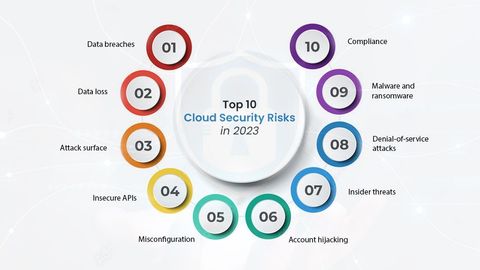
Common Cloud Security Threats
Cloud environments can face a range of security threats.
Common examples include:
Account compromise
Credential theft
Misconfigured storage
Excessive permissions
Malware
Ransomware
Vulnerable applications
Insecure APIs
Insider misuse
Supply-chain attacks
Data leakage
Denial-of-service attacks
The relevance of each risk depends on the organization's architecture, applications, data, users, and cloud provider.
Cloud Misconfiguration Risk
Misconfiguration is an important cloud-security consideration.
Examples can include:
Publicly accessible storage
Unrestricted network access
Excessive administrative privileges
Weak security settings
Inadequate encryption configuration
Unprotected databases
Missing logging
Unrestricted application interfaces
Configuration-management processes can help organizations identify and address inappropriate settings.
Data Protection in the Cloud
Organizations should understand how sensitive data is collected, stored, processed, transferred, and deleted in cloud environments.
Data-protection controls may include:
Encryption
Access restrictions
Data classification
Key management
Data-loss prevention
Secure data transfer
Retention policies
Backup controls
Secure deletion
Data-access monitoring
Organizations should also understand whether cloud providers, subcontractors, or other third parties can access or process their information.
Cloud Identity and Access Management
Identity management is central to cloud risk management.
Organizations may use:
Multi-factor authentication
Single sign-on
Role-based access control
Least-privilege permissions
Privileged access management
Conditional access
Identity lifecycle management
Access reviews
Permissions should correspond to legitimate business requirements.
Administrative identities should receive additional protection because compromise of privileged accounts can affect multiple cloud resources.
Shared Responsibility Model
Cloud security responsibilities are often divided between the cloud provider and the customer.
Depending on the service model, the provider may manage certain infrastructure components while the customer remains responsible for areas such as:
User permissions
Data
Application configuration
Security settings
Authentication
Access policies
The exact responsibilities depend on the cloud service and provider.
Organizations should document their responsibilities rather than assuming that the cloud provider manages every security requirement.
Cloud Compliance
Cloud environments can be subject to different legal, regulatory, and contractual requirements.
Relevant areas may include:
Data-protection regulations
Financial-sector requirements
Healthcare information requirements
Payment-card security
Government security requirements
Industry standards
Contractual security obligations
Compliance requirements can depend on:
Data type
Customer location
Organization location
Industry
Cloud architecture
Regulatory status
Contractual relationships
A cloud platform's certifications do not automatically make every customer deployment compliant.
Cloud Security Frameworks and Standards
Organizations may use recognized frameworks to structure cloud-risk programs.
Relevant resources can include:
NIST Cybersecurity Framework
NIST cloud-security guidance
ISO/IEC 27001
ISO/IEC 27017
CIS Controls
Cloud Security Alliance guidance
SOC 2
Industry-specific security requirements
Organizations should select frameworks based on their actual security and compliance objectives.
Cloud Governance
Cloud governance establishes rules for how cloud resources are created, managed, monitored, and retired.
A governance program can define:
Approved cloud providers
Account structures
Resource naming
Identity policies
Security configurations
Data classification
Encryption requirements
Logging requirements
Backup requirements
Cost controls
Compliance requirements
Resource lifecycle procedures
Governance can help reduce inconsistent configurations across different cloud environments.
Cloud Network Security
Network security can involve multiple layers.
Organizations may use:
Network segmentation
Firewalls
Private connectivity
Security groups
Network access controls
Secure remote access
Traffic monitoring
API security
Intrusion detection
Cloud-native network controls should be reviewed alongside traditional network-security architecture.
Cloud Monitoring and Logging
Cloud environments can generate large volumes of security and operational information.
Organizations may monitor:
Authentication activity
Administrative actions
Configuration changes
Network events
Application activity
Data access
Security alerts
API activity
Centralized logging can help security teams investigate unusual activity and support incident-response processes.
Log-retention requirements vary according to organizational needs and applicable rules.
Vulnerability and Configuration Management
Cloud applications and infrastructure should be reviewed for vulnerabilities and inappropriate configurations.
A cloud vulnerability-management process can include:
Asset discovery
Configuration assessment
Vulnerability scanning
Risk prioritization
Remediation
Verification
Documentation
Organizations should consider both technical severity and business impact when prioritizing remediation.
Cloud Backup and Disaster Recovery
Cloud adoption does not eliminate the need for backup and recovery planning.
Organizations should evaluate:
Backup frequency
Recovery objectives
Data redundancy
Geographic considerations
Backup access controls
Backup encryption
Restoration testing
Ransomware protection
Recovery procedures
Backups should be tested periodically to determine whether important information and systems can actually be restored.
Third-Party and Cloud Provider Risk
Cloud providers and technology vendors can become important parts of an organization's operational environment.
Third-party risk reviews may consider:
Security controls
Data handling
Compliance certifications
Incident notification
Subcontractors
Data location
Business continuity
Service availability
Contractual obligations
Offboarding procedures
Organizations should review provider documentation and contractual terms before relying on cloud infrastructure for critical operations.
Cloud Risk Assessment
A cloud risk assessment can evaluate each important workload or environment.
A basic assessment may consider:
| Risk Area | Example Question |
|---|---|
| Data | What information is stored or processed? |
| Access | Who can access the environment? |
| Configuration | Are security settings appropriate? |
| Availability | What happens if the service becomes unavailable? |
| Compliance | Which requirements apply? |
| Vendor | What third parties are involved? |
| Recovery | Can critical systems and data be restored? |
| Monitoring | Are important events recorded? |
The assessment should be updated when major systems, applications, providers, or regulatory requirements change.
Incident Response in Cloud Environments
Cloud incidents can require coordination between internal teams and external providers.
Potential incidents include:
Compromised accounts
Data exposure
Malware
Unauthorized configuration changes
API abuse
Credential theft
Ransomware
Service disruption
Incident-response plans should establish:
Detection procedures
Escalation paths
Provider contacts
Evidence-preservation procedures
Containment actions
Communication responsibilities
Recovery procedures
Regulatory notification processes
Cloud Security and Zero Trust
Zero-trust security emphasizes verifying access rather than automatically trusting users or systems based on network location.
Cloud environments can support zero-trust approaches through:
Strong identity verification
Multi-factor authentication
Device controls
Least privilege
Continuous monitoring
Conditional access
Application-level controls
Segmentation
Zero trust should be treated as an architectural approach rather than a single security product.
AI and Cloud Risk
Artificial intelligence can introduce additional cloud-risk considerations.
Organizations may need to evaluate:
Where AI workloads process information
Whether sensitive data is used
Model-access permissions
API security
Third-party AI providers
Data retention
Intellectual-property considerations
Monitoring
Model-related risks
AI workloads should be incorporated into existing security, privacy, governance, and risk-management processes where applicable.
Recent Developments
Cloud risk management continues to evolve alongside:
Multi-cloud environments
Hybrid cloud infrastructure
Cloud-native applications
Serverless computing
Artificial intelligence
Automated security monitoring
Identity-based security
Zero-trust architectures
Software supply-chain security
Continuous compliance monitoring
Organizations increasingly need to manage security consistently across multiple technology environments rather than treating each cloud system independently.
Cloud Risk Management Checklist
Organizations can review:
Identify critical cloud workloads
Inventory cloud accounts and resources
Classify sensitive information
Review user and administrative access
Implement appropriate authentication
Review cloud configurations
Establish encryption controls
Monitor important activity
Maintain security logs
Assess third-party providers
Test backups and recovery
Document incident-response procedures
Review applicable compliance requirements
Establish cloud-governance policies
Conduct periodic risk assessments
Review cloud architecture when major changes occur
Tools and Resources
Useful resources for cloud risk management include:
Cloud security posture management tools
Identity and access management platforms
Cloud access security broker technologies
Security information and event-management systems
Vulnerability scanners
Configuration-management tools
Data-loss prevention systems
Encryption and key-management platforms
Backup and recovery systems
Cloud governance frameworks
NIST cybersecurity guidance
ISO/IEC security standards
Cloud Security Alliance resources
CIS security controls
Frequently Asked Questions
What is cloud risk management?
Cloud risk management is the process of identifying, assessing, controlling, and monitoring risks associated with cloud-based systems, applications, data, providers, and technology infrastructure.
What are common cloud security risks?
Common risks include account compromise, misconfigured resources, excessive permissions, data exposure, insecure APIs, vulnerable applications, malware, ransomware, and third-party security issues.
What is the cloud shared responsibility model?
The shared responsibility model divides security responsibilities between a cloud provider and its customer. The exact responsibilities depend on the cloud service and provider.
How can businesses protect data in the cloud?
Organizations can use appropriate encryption, access controls, authentication, data classification, monitoring, backup, retention, and secure-transfer controls based on their risk and compliance requirements.
How often should cloud risk assessments be performed?
There is no universal schedule. Organizations should consider risk levels, system changes, new cloud services, security incidents, regulatory developments, and business requirements when establishing review cycles.
Conclusion
Cloud risk management connects cloud security, data protection, identity management, compliance, governance, monitoring, vendor risk, and business continuity.
A structured program can help organizations identify important cloud risks, establish appropriate controls, understand shared responsibilities, protect sensitive information, and maintain evidence of security and compliance activities.
Cloud environments change quickly, so risk assessments and security controls should be reviewed as technology, workloads, providers, applications, and regulatory requirements evolve.